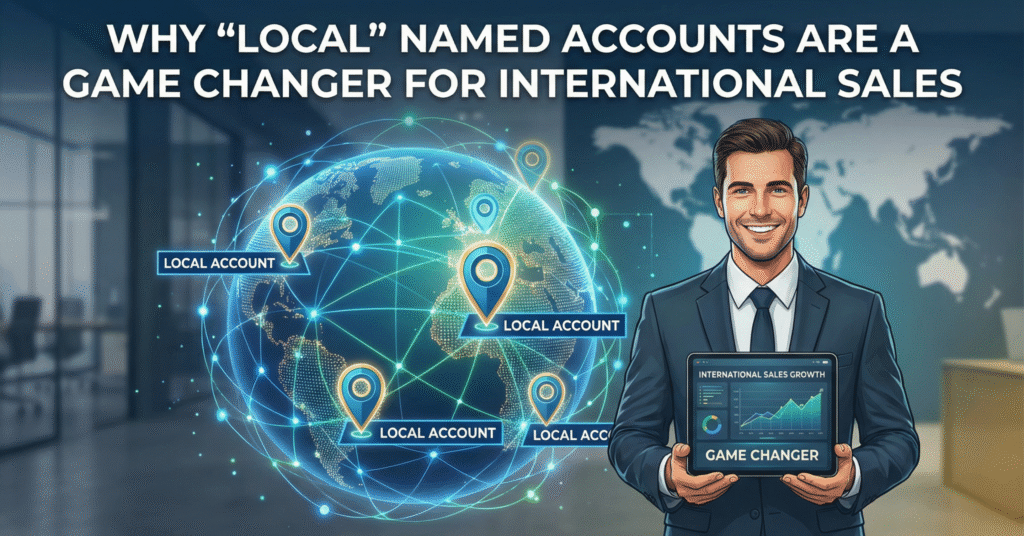
Winning international sales is about much more than having the best product or the sharpest price. When a potential client in Manila, Munich, or Miami is ready to pay, the moment they encounter an unfamiliar foreign bank account, trust evaporates and deals collapse. Local named accounts are the single most powerful infrastructure upgrade a UK business can make to eliminate that friction — presenting a professional, in-country payment identity to customers around the world, while keeping every penny firmly under your control.
At PhiliPay, our entire platform is built on one guiding principle: Go Global, Stay Local. That means giving your business the tools to look, feel, and transact like a native in every market you serve — without the complexity, cost, or compliance headaches of opening physical entities abroad.
This guide breaks down exactly why local named accounts are transforming international B2B and B2C sales, how they work in practice, and how you can deploy them inside your business starting today.
Table of Contents
What Are Local Named Accounts — and Why Do They Matter?
A local named account is a business account registered under your company’s name that allows you to receive payments from clients worldwide as though your business were a local entity in their country. Instead of asking a client in the Philippines to make a costly international wire transfer to a UK IBAN, you provide them with local Philippine bank details — issued in your business name — so they pay domestically, quickly, and cheaply.
The “named” element is critical. This is not a pooled or shared account. It is not a virtual account tied to a payment processor’s generic reference number. Your company name appears directly on the account details your client sees, reinforcing legitimacy and building the kind of trust that converts quotes into contracts.
For businesses connecting the UK with global markets — particularly the Philippines — local named accounts sit at the intersection of compliance, efficiency, and commercial strategy. They are not a workaround; they are the new standard infrastructure for serious international operations.
The Real Cost of Looking “Foreign” to International Buyers
Before we explore the solutions, it is worth quantifying the problem. When international buyers see unfamiliar foreign account details, a predictable chain of events unfolds — and every link in that chain costs you money and opportunity.
The friction chain:
- The client’s bank flags the international transfer for additional compliance checks
- The client is charged a correspondent banking fee (often £15–£40 per transaction)
- Exchange rate losses are applied at the interbank spread — often 2–4% above mid-market
- Processing delays of 3–5 business days create cash flow uncertainty for your business
- The administrative burden discourages smaller, more frequent orders — killing recurring revenue potential
According to data from the World Bank, the average cost of sending a cross-border business payment remains stubbornly high, with fees representing a significant proportion of transaction value for SME-sized payments: https://www.worldbank.org/en/topic/financialsector/brief/remittances
Furthermore, research published by McKinsey & Company highlights that cross-border payment volumes are growing rapidly, yet friction and cost remain the primary barriers preventing SMEs from fully capitalising on international market opportunities: https://www.mckinsey.com/industries/financial-services/our-insights/global-payments-2023-the-next-chapter
In short: every time a client is asked to navigate an expensive international wire transfer, you are asking them to absorb a cost and an inconvenience that your competitors — those already using local named accounts — are not imposing on their buyers.
5 Ways Local Named Accounts Unlock International Sales Growth
1. Instant Trust and Professional Credibility
In B2B sales, perception is commercial reality. When you send an invoice carrying local bank details registered in your business name, the message to your international client is unmistakable: this is an established, professionally structured company that understands our market.
Compare that to receiving a payment request directing funds to an obscure foreign IBAN. Even the most willing buyer will pause. Questions arise about legitimacy, about currency conversion uncertainty, and about whether their internal finance team will approve the wire.
Local named accounts eliminate that hesitation entirely. Your client pays in their own currency, through their familiar domestic banking channels, to an account bearing your company name. The deal moves forward. The relationship strengthens. The invoice gets paid faster.
This trust premium is not cosmetic. In markets like the Philippines, where relationship-driven business culture places enormous weight on professional credibility and financial reliability, presenting local payment details is a genuine competitive differentiator that opens doors traditional foreign banking simply cannot.
2. Eliminating Cross-Border Payment Friction
The mechanics of a traditional international wire transfer are needlessly complex. Funds typically pass through multiple correspondent banks, each applying fees and processing delays, before arriving at the beneficiary. SWIFT codes, IBAN numbers, and intermediary bank details create opportunities for human error and compliance holds.
Local named accounts bypass this entire chain. When your client pays using local account details, the transaction behaves exactly like a domestic payment — fast, inexpensive, and straightforward. The complexity is absorbed by the infrastructure behind the account, not by your client or your team.
For businesses with high-volume international sales — exporters, BPO operators, e-commerce merchants, and professional services firms — removing this friction can directly translate into a measurable improvement in payment conversion rates and average days sales outstanding (DSO).
3. Slashing Hidden FX and Correspondent Banking Fees
The cost of cross-border payments is rarely transparent when using traditional banking infrastructure. The headline transfer fee is only the beginning. Correspondent banks charge lifting fees. Your own bank applies a foreign exchange spread. The receiving bank may deduct arrival charges. By the time the payment completes, a significant percentage of the invoice value has evaporated.
Multi-currency business accounts paired with local named accounts break this model. Funds received in your local named account are held in the relevant currency — Philippine Peso, US Dollars, Euros — until you choose to convert them, at a time and rate that reflects your strategic preference rather than your bank’s convenience.
At PhiliPay, we provide competitive exchange rates on GBP, EUR, USD, CAD, and PHP conversions, with full transparency on pricing. There are no hidden spreads buried in the small print. What you see is what you receive. That is the kind of transparent financial relationship that serious international businesses deserve.
4. Faster Settlement = Better Cash Flow
Cash flow is the oxygen of any growing business. International payment delays — often 3 to 7 business days with correspondent banking chains — create working capital gaps that constrain growth, complicate supplier payments, and force businesses to maintain unnecessarily large liquidity buffers.
Local named accounts dramatically accelerate settlement timelines. Domestic transactions within the Philippines, for example, can settle on the same day or within 24 hours. For UK businesses paying suppliers, freelancers, or BPO teams in the Philippines, the combination of local named accounts and mass payment capabilities means funds move faster, reconciliation is simpler, and everyone operates with greater financial certainty.
Faster settlement is not merely an operational improvement — it is a commercial advantage. Suppliers who receive payment reliably and promptly prioritise your orders. Clients who are invoiced via simple local payment details pay sooner. The cumulative impact on working capital management is substantial.
5. Scaling Into New Markets Without Opening a Foreign Entity
Establishing a legal entity in a foreign jurisdiction is expensive, time-consuming, and operationally demanding. Corporate registration, local compliance, tax obligations, HR infrastructure — the overhead of a formal foreign subsidiary can run to tens of thousands of pounds before you have transacted a single pound of revenue.
Local named accounts provide a credible, compliant alternative for businesses in the earlier stages of international market entry. You can accept payments locally, engage clients professionally, and build a genuine market presence without the full complexity of a foreign subsidiary — all from your UK base, through a single, unified platform.
For UK businesses targeting the Philippines specifically, this is transformative. The Philippines represents a major and growing market for business process outsourcing, digital services, and professional partnerships. Having local payment infrastructure in place from day one signals commitment, enables frictionless transactions, and positions your business as a serious, long-term market participant.
Local Named Accounts vs. Traditional Business Banking: A Direct Comparison
Understanding the practical difference between local named accounts and what your current high-street bank offers is essential for making an informed decision.
| Feature | Traditional Business Bank | Local Named Accounts (PhiliPay) |
|---|---|---|
| Account held in your company name | ✅ Yes | ✅ Yes |
| Local account details per market | ❌ No | ✅ Yes |
| Multi-currency holding | Limited / costly | ✅ GBP, EUR, USD, CAD, PHP |
| FX transparency | Opaque spread | ✅ Clear, competitive rates |
| Mass / bulk payment capability | Rarely | ✅ Built-in |
| Processing time (Philippines) | 3–5 business days | ✅ Same day / 24 hours |
| Dedicated cross-border support | Limited | ✅ Specialist team |
| Cost per international payment | High (£15–£40+) | ✅ Significantly lower |
The contrast is stark. Traditional banks were built for domestic commerce and have adapted to international payments reluctantly and expensively. Platforms like PhiliPay were purpose-built for exactly this use case — high-quality, transparent, efficient cross-border financial operations.
Who Benefits Most from Local Named Accounts?
While virtually any business with international revenues or payments can benefit, local named accounts provide the greatest impact for specific business profiles:
- UK businesses with Philippine suppliers, partners, or remote teams who need to make fast, cost-effective regular payments in PHP without SWIFT delays or opaque FX markups.
- BPO operators and outsourcing businesses managing payroll or contractor payments across multiple recipients in the Philippines, where mass payment capability combined with local account infrastructure is essential.
- E-commerce and digital services businesses receiving payments from international customers who need to trust that their payment is going somewhere professional, local, and secure.
- Professional services firms — legal, consulting, marketing, technology — invoicing international clients who need frictionless, currency-appropriate payment options to maintain commercial relationships.
- Import/export businesses managing supplier payments to the Philippines and requiring timely, predictable settlement to maintain supply chain integrity.
- Startups and scale-ups entering the Philippine market for the first time who need credible local payment infrastructure without the overhead of a full legal entity.
If your business fits any of these profiles, the case for upgrading your international payment infrastructure is compelling — and the pathway to doing so is more straightforward than you might expect.
How PhiliPay’s Local Named Accounts Work in Practice
PhiliPay has designed its platform specifically for businesses that need local named accounts to support professional international operations between the UK and the Philippines. Here is how the end-to-end process works:
Step 1 — Register Your Business Account
Open your PhiliPay business account online. The registration process is streamlined, compliance-driven, and designed to get serious businesses operational quickly. Your account is registered under your company’s name — ensuring every transaction reflects your professional identity. Open your PhiliPay business account here →
Step 2 — Access Local Named Account Details
Once verified, your business receives local account details that function as domestic payment destinations for your clients and partners. Clients in the Philippines see Philippine account details bearing your company name. No SWIFT transfers. No international wire complexity.
Step 3 — Hold Multiple Currencies
Funds received are held in your multi-currency account. PhiliPay supports GBP, EUR, USD, CAD, and PHP — meaning you can receive in one currency, hold strategically, and convert when rates are favourable. You are always in control of when and how you exchange.
Step 4 — Convert and Transfer at Competitive Rates
When you are ready to convert or move funds, PhiliPay applies transparent, competitive FX rates without the hidden spreads typical of high-street banking. For Philippine Peso conversions specifically, our rates reflect genuine market competitiveness — not the inflated margins of banks that treat international FX as a profit centre rather than a service.
Step 5 — Make Mass Payments Where Needed
For businesses making regular payments to multiple recipients in the Philippines — payroll, supplier runs, contractor fees — PhiliPay’s mass payment capability allows you to process bulk disbursements efficiently, accurately, and cost-effectively from a single platform instruction.
Compliance, Security, and Safeguarding: What You Need to Know
A legitimate concern for any business adopting new financial infrastructure is compliance and security. At PhiliPay, these are not box-ticking exercises — they are foundational to everything we do.
Payment services for PhiliPay Ltd are provided by Sciopay Ltd, a company incorporated in England & Wales (Registration No: 12352935). Sciopay Ltd is licensed and regulated by HMRC as a Money Service Business (MSB), Licence No: XCML00000151326, and is authorised by the Financial Conduct Authority (FCA) as an Authorised Payment Institution, Firm Reference Number: 927951.
This regulatory framework means your funds are handled under rigorous UK financial oversight. Critically, all relevant client funds are held in separate accounts with tier-one banks, ring-fenced from PhiliPay’s own operational accounts. This ensures complete protection of your money in any scenario — including in the highly unlikely event of company insolvency.
PhiliPay employs advanced encryption, secure transaction channels, and strict AML/KYC compliance procedures to protect both your funds and your data at all times. Our approach to security is not a feature — it is a non-negotiable operational standard.
For full details on how we handle your data and protect your funds, you are welcome to review our Privacy Policy and Safeguarding Policy.
If you have bespoke compliance requirements, complex corporate structures, or specific regulatory questions related to your sector, our specialist team is available to guide you through every consideration. Speak to the PhiliPay team directly →
Getting Started: Your Next Step
The gap between where your international payment infrastructure is today and where it needs to be to support serious global growth is entirely bridgeable — and it starts with a single, practical decision.
Local named accounts are not a future technology. They are available right now, through a platform built specifically for UK businesses with global ambitions. PhiliPay has already helped businesses eliminate SWIFT delays, slash FX costs, accelerate Philippine Peso settlements, and present a professional payment identity to clients in every market they serve.
The competitive advantage in international sales increasingly belongs to businesses that make it easy for their clients to pay. Local payment details in your company name are the single most effective way to achieve that — and the single most common infrastructure gap we see in growing UK businesses managing cross-border relationships.
The time to act is now. International payment expectations are rising. Clients who pay easily once will pay again. Those who encounter friction find a competitor who removes it.
Ready to stop losing international sales to payment friction?
Open your PhiliPay business account today → and start receiving payments from clients worldwide as though your business were right there in their market.
Key Takeaways
- Local named accounts allow your business to receive international payments as though you are a domestic business in your client’s market — eliminating wire transfer complexity, cost, and distrust.
- Traditional banks are structurally unsuited to modern cross-border payment needs. Purpose-built platforms like PhiliPay deliver faster settlement, lower costs, and complete FX transparency.
- The commercial impact spans trust-building, payment conversion rates, cash flow acceleration, FX cost reduction, and market entry speed.
- UK businesses with Philippines connections — BPOs, outsourcing firms, exporters, professional services companies — have the most to gain immediately.
- PhiliPay’s infrastructure is FCA-regulated, fully ring-fenced, and built on the principle that your financial relationships deserve complete transparency.
PhiliPay Ltd — Registered in the UK (Company No: 16596898). 20 Wenlock Road, N1 7GU, London, United Kingdom.
Payment services provided by Sciopay Ltd. FCA Authorised Payment Institution, FRN: 927951.
Have a question about whether local named accounts are right for your business? Contact our team — we’re here to help you find the right structure for your international operations.