Table of Contents
Pay by Link is a fast, secure way for businesses to collect card and digital payments without maintaining a full e-commerce site. For busy finance teams and small-to-medium enterprises working with international customers, Pay by Link removes friction, shortens sales cycles, and improves cash flow — often in seconds. This article explains how Pay by Link works, why it matters for B2B and cross-border payments, security and compliance expectations, implementation best practices, metrics to track, and how PhiliPay’s Pay by Link solution is designed for businesses dealing with the Philippines and global clients.
What is Pay by Link?
Pay by Link is a payment method where a merchant generates a secure URL or button that a customer can click to complete a transaction. The link opens a hosted payment page (or mobile flow) that accepts credit/debit cards, wallets or local payment methods without the customer visiting a merchant website checkout.
Because the merchant does not need a fully integrated e-commerce store or separate payment gateway integration for every channel, Pay by Link is ideal for remote selling (phone, email, chat), recurring invoice follow-ups, and one-off B2B transactions. This reduces time spent chasing invoices and converts conversations into payments with a single click — frequently settling in business days rather than weeks. Philipay
Why Pay by Link matters now (business case & data)
Three macro trends make Pay by Link critical for modern finance teams:
- Digital payments are expanding rapidly. Global payment volumes and digital transaction values continue to rise as businesses and consumers prefer frictionless, remote payment options. (According to McKinsey, global payments continue to grow and evolve with digital interfaces simplifying the experience for end users.) (According to a report by McKinsey, this trend is growing: https://www.mckinsey.com/industries/financial-services/our-insights/global-payments-in-2024-simpler-interfaces-complex-reality). McKinsey & Company
- Demand for on-the-spot electronic collection is increasing. Businesses want to convert calls, emails and chats into instant payments without building or maintaining a commerce site. Industry research indicates specific pay-by-link market growth as merchants adopt hosted link solutions to reduce friction. (According to a market report, the global Pay by Link market value reached USD 8.2 billion in 2024 with high projected growth.) (According to a report by Growth Market Reports, this trend is growing: https://growthmarketreports.com/report/pay-by-link-market). Growth Market Reports
- Card-Not-Present (CNP) transactions and fraud risk are rising. CNP channels like payment links are convenient but attract higher fraud risk, making secure hosted pages and strong anti-fraud controls essential. Analysts and payments vendors report notable increases in CNP fraud, which requires identity and transaction-level controls for Pay by Link offerings. (See payments security research and industry warnings about rising CNP fraud.) (According to a report by ACI Worldwide, CNP fraud is a growing concern: https://www.aciworldwide.com/card-not-present-fraud). ACI Worldwide
Finally, these trends sit alongside accelerating digital adoption. The World Bank’s digital progress work documents broader digital payment adoption worldwide — a context in which Pay by Link becomes not just convenient but necessary. (According to World Bank interactive analysis, digital payments and digital ID systems are important enablers.) (According to a report by The World Bank, this trend is growing: https://documents1.worldbank.org/curated/en/099031924192524293/pdf/P180107173682d0431bf651fded74199f10.pdf). World Bank
How Pay by Link works — step-by-step
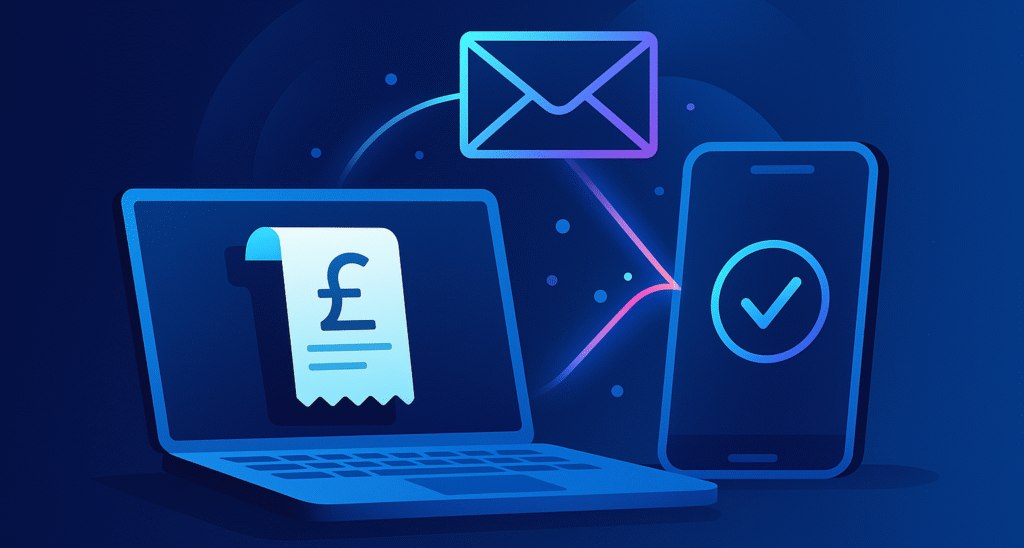
Pay by Link flows are intentionally simple for the payer and controlled by the merchant:
- Create the payment request. The merchant enters amount, currency, description, optional invoice number and an expiration. The payment link is generated from a secure merchant portal or API.
- Send the link. Links can be delivered over email, SMS, messaging apps, or within chat and CRM systems.
- Payer clicks & pays. Clicking opens a hosted payment page where the customer selects a payment method and authorises the transaction.
- Confirmation & settlement. The payer gets a receipt; the merchant receives notification and settlement follows into the merchant account per the provider’s timelines.
Because the payment page is hosted and PCI-certified by the payments provider, the merchant avoids heavy PCI scope while still offering branded receipts and configurable fields. That’s why Pay by Link is often the quickest route from invoice to cash.
Security, fraud and compliance for Pay by Link
Security must be built into every link:
- Hosted PCI compliance: Choose a provider whose hosted page reduces your PCI DSS scope (merchant does not store card data).
- Tokenisation & encryption: Tokenise card details and encrypt the transmission end-to-end.
- 3DS & risk scoring: Use 3-D Secure flows where appropriate and real-time fraud scoring to reject suspicious attempts.
- Link lifecycle controls: Expiry times, one-time use links, and limited capture windows reduce replay risk.
- Audit trail & receipts: Full transactional logs and email receipts support disputes and reconciliation.
Remember: convenience attracts fraudsters. Operational controls (like payment amount limits, customer verification for high-value payments, and whitelisting trusted buyers) must be part of any Pay by Link deployment. Industry vendors and banks emphasise layered defenses for CNP channels. ACI WorldwideFICO
Use cases: who benefits most from Pay by Link
Pay by Link is highly applicable across many B2B and B2C scenarios:
- Professional services & freelance invoices: Convert emailed invoices into instant payments.
- BPOs & remote employer payments: Allow overseas clients or payroll accounts to top up or pay fees quickly.
- Wholesale & bespoke orders: Send payment links for custom quotes or deposits.
- Mass payment follow-ups: Use pay-by-link for subscription renewals or failed direct-debit recoveries.
- Event, training, and consultancy bookings: Close sales over calls or messaging without an e-commerce rebuild.
For businesses operating with Filipino suppliers or teams, a provider like PhiliPay combines multi-currency collection with local payout capabilities — reducing FX friction and simplifying reconciliation.
Pricing, fees and cost control when using Pay by Link
Pricing models vary by provider — common elements include:
- Per-transaction fee: A fixed fee plus a percentage of the transaction.
- Currency conversion margin: If you collect in one currency and convert to another, watch the FX spread.
- Chargeback & dispute fees: CNP channels typically have higher dispute rates — factor in potential chargebacks.
- Volume tiers: Many providers offer reduced pricing at scale or for pre-approved corporate accounts.
To control cost:
- Use settlement currency alignment (collect in the currency you expect).
- Avoid unnecessary conversion steps.
- Reconcile fees monthly and negotiate volume discounts as your transaction volume grows.
PhiliPay’s pricing is designed for cross-border scenarios — check service details and negotiate for volume as you scale. (Learn more about our pricing and services on the PhiliPay site.)
Implementation checklist & best practices for Pay by Link
Use this practical checklist for a rapid, low-risk rollout:
- Provider selection: Ensure PCI compliance, strong fraud tools, and multi-currency support.
- Branding: Configure logos and email templates so links look professional and trustworthy.
- Link security: Enable expiry, single-use links, and IP-tailored restrictions for high-value payments.
- Automation: Integrate with CRM, invoicing, or accounting systems to auto-generate links for invoices.
- Customer instructions: Provide clear minimal steps in the email or SMS to reduce drop-off.
- Reporting & alerts: Enable real-time settlement notifications and daily reconciliation exports.
- Training: Teach sales and ops teams to use links as a primary collection tool — not a last resort.
Short checklist item: test every flow (desktop, mobile, wallet) and simulate disputes for your team to be prepared.
Measuring success: KPIs and reporting for Pay by Link
Track these KPIs to measure impact and ROI:
- Click-to-pay conversion rate: % of links that result in successful payment.
- Time-to-cash: Average time from invoice to settlement.
- Average order value (AOV): Monitor whether links produce larger or smaller payments than traditional channels.
- Chargeback rate & dispute cost: Keep these below scheme thresholds; high rates will increase costs.
- Cost-per-payment: All-in cost including fees, FX, and dispute handling.
Use these KPIs to tune email copy, link expiry, and follow-up cadence. Well-designed Pay by Link flows typically reduce time-to-cash and improve conversion compared to manual bank transfers.
Common pitfalls and how to avoid them with Pay by Link
Pitfall: Sending unbranded or cryptic links that customers ignore or flag as suspicious.
Fix: Use branded templates, clear copy, and an embedded invoice summary.
Pitfall: Not matching payment currency expectations (payer charged in GBP when they expected PHP).
Fix: Indicate currency clearly and offer payer-side currency selection when possible.
Pitfall: Weak fraud controls for high-value transactions.
Fix: Require KYC or manual approval for links over a threshold and enable 3DS.
Pitfall: Poor reconciliation between link reference numbers and accounting records.
Fix: Use invoice numbers in the link metadata and auto-import settlement reports into your ERP.
Avoiding these mistakes makes Pay by Link an accelerant for cash flow, not a compliance or ops headache.
How PhiliPay’s Pay by Link helps international businesses
PhiliPay’s Pay by Link is purpose-built for businesses that trade with or have teams in the Philippines:
- Multi-currency collection: Accept GBP, EUR, USD, CAD and convert to PHP at competitive, transparent FX rates.
- Fast settlement: Typical Pay by Link settlements are processed within 1–3 business days, improving time-to-cash for cross-border transactions.
- Secure, branded hosted pages: Reduce PCI scope while presenting a trusted, professional payment experience.
- Mass payments & reconciliation: Combine collection via Pay by Link with PhiliPay’s multi-currency and mass-payout features to streamline international supplier and payroll payments.
Want to see how this works in your business? Learn more about our approach and team on our About page: Learn about PhiliPay.
If you’re ready to discuss a tailored Pay by Link implementation for your cross-border payments, contact PhiliPay for more information. To start streamlining international transactions, register for a PhiliPay account today and experience the difference: Register with PhiliPay.
Conclusion & next steps
Pay by Link is a practical, low-friction route to faster collections and better customer experiences — particularly for businesses operating across borders or without a dedicated e-commerce storefront. By pairing strong fraud controls, clear customer messaging, and reconciliation automation, Pay by Link becomes a secure revenue accelerator.
Actionable next steps (30–60 minute plan):
- Run a one-week pilot sending Pay by Link for 10–20 invoices and track click-to-pay and time-to-cash.
- Configure branded templates, expiry rules, and one-time link options.
- Enable real-time settlement notifications and verify reconciliation fields.
- If you operate with Philippine suppliers or teams, contact PhiliPay for an onboarding call and tailored FX/settlement options. Contact us.
Quick FAQ
Q: Can I accept cards with Pay by Link without PCI fuss?
A: Yes—if your provider offers hosted pages and tokenisation, you reduce PCI scope substantially.
Q: Will Pay by Link increase fraud?
A: CNP channels have higher inherent risk; layered controls (3DS, fraud scoring, tokenisation) mitigate this risk effectively. ACI Worldwide
Q: How fast is settlement?
A: Many providers (including PhiliPay) settle within 1–3 business days for Pay by Link transactions.