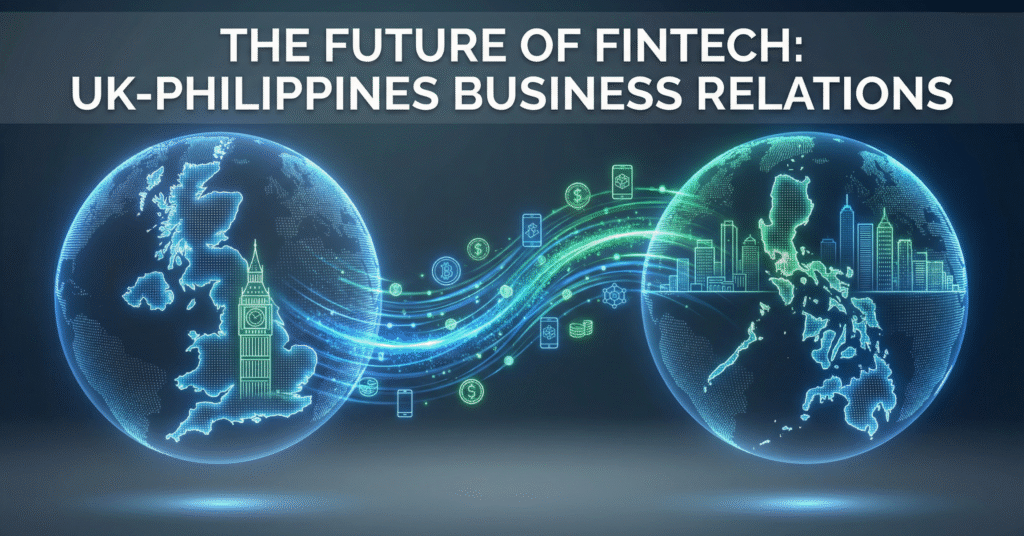
The UK Philippines FinTech trends reshaping cross-border commerce are no longer a forecast — they are already happening, and businesses that adapt now will hold a decisive competitive advantage heading into 2026 and beyond. As trade, outsourcing, and investment between the United Kingdom and the Philippines continue to accelerate, the financial infrastructure powering these relationships has never been more critical — or more innovative. Whether you manage a BPO operation, export goods, or pay a distributed workforce in Manila, understanding where the FinTech landscape is heading could mean the difference between thriving globally and leaving money on the table.
Table of Contents
Why the UK-Philippines Corridor Is a FinTech Priority
The United Kingdom and the Philippines share a uniquely powerful economic relationship. The Philippines is one of the world’s largest sources of outsourced talent, boasting over 1.5 million BPO professionals, while the UK remains one of the top destinations for Filipino remittances and a major hub for multinational businesses with Philippine operations.
According to data from the World Bank, the Philippines consistently ranks among the top remittance-receiving nations globally, with inbound transfers exceeding $37 billion USD annually — a significant proportion flowing from UK-based businesses and individuals: https://www.worldbank.org/en/topic/migrationremittancesdiasporaissues/brief/migration-remittances-data
Yet despite this volume, traditional banking channels remain painfully slow, expensive, and opaque. Hidden FX margins, multi-day settlement windows, and a lack of real-time visibility have long frustrated businesses on both ends of this corridor.
This is precisely where modern UK Philippines FinTech trends are creating transformative change — and why purpose-built platforms like PhiliPay are becoming the financial backbone of UK-Philippines commerce.
Trend 1: The Rise of Real-Time Cross-Border Payments
Why Speed Is Now a Competitive Differentiator
One of the most significant UK-Philippines FinTech trends of the past two years is the aggressive push towards real-time or near-real-time international settlement. Historically, a SWIFT wire transfer from a London-based company to a Philippine bank account could take 3–5 business days, carrying unpredictable fee structures and poor exchange rates.
Today, that paradigm is being dismantled. Advances in payment rails, API-driven banking, and FinTech-to-FinTech connectivity are enabling same-day or next-day settlement to Philippine Peso accounts — even for high-value B2B transactions.
Why this matters for your business:
- Suppliers and contractors in the Philippines receive funds faster, improving trust and operational continuity
- Businesses eliminate the cash-flow risk associated with multi-day settlement windows
- Finance teams gain predictable, auditable payment timelines
According to research published by McKinsey & Company, real-time payments infrastructure is projected to handle over $200 trillion in transaction value globally by 2027, with emerging market corridors — including Southeast Asia — representing the fastest-growing segment: https://www.mckinsey.com/industries/financial-services/our-insights/the-2023-mckinsey-global-payments-report
For UK businesses paying Philippine-based teams or partners, speed is no longer a luxury — it is a baseline expectation.
Trend 2: Multi-Currency Accounts Are Replacing Traditional Business Banking
Hold More. Convert Smarter. Control Everything.
Perhaps the single most commercially impactful development in cross-border payments UK Philippines is the mass adoption of multi-currency corporate accounts. Rather than converting GBP to PHP at the point of payment — and absorbing whatever rate the bank offers that day — businesses can now hold funds in multiple currencies simultaneously.
A named multi-currency account allows a UK business to:
- Receive client payments in GBP, EUR, USD, and CAD without forced conversion
- Hold those balances until exchange rates are favourable
- Convert to Philippine Peso at competitive, transparent rates when operationally appropriate
- Issue payments locally in the Philippines as if operating a domestic account
This is not merely a convenience — it is a fundamental restructuring of how currency risk is managed. Businesses that previously budgeted for 2–4% FX losses on international payroll are discovering they can reduce those costs by more than half using structured multi-currency strategies.
PhiliPay’s multi-currency business accounts are purpose-engineered for exactly this use case, offering named accounts that give your company a credible, professional presence in multiple currency zones — without the complexity of opening foreign bank accounts.
Trend 3: Mass Payments Technology Is Transforming BPO Payroll
Paying Dozens — or Thousands — of People Has Never Been More Efficient
The UK’s BPO sector has an enormous footprint in the Philippines. British companies outsource everything from customer service and IT support to legal processing and financial analysis to highly skilled Philippine-based teams. This creates a consistent, high-volume payroll challenge: how do you pay hundreds of remote workers efficiently, compliantly, and cost-effectively?
The answer in 2025 and beyond is mass payments technology. Rather than processing individual transfers — each incurring its own fee and processing delay — businesses can now batch payroll runs into a single instruction, disbursing funds to multiple recipients across the Philippines simultaneously.
Key business benefits of mass payments:
- Dramatically reduced processing time: A payroll run that once took hours now takes minutes
- Lower per-transaction costs: Bulk processing economics mean you pay less per payment
- Simplified reconciliation: Single batch instructions produce clean, consolidated reporting
- Reduced errors: Automated validation reduces manual entry mistakes
- Scalability: Whether you pay 10 contractors or 10,000 employees, the process scales seamlessly
For UK-based firms managing BPO relationships in the Philippines, this is one of the most immediately impactful UK Philippines FinTech trends to operationalise. The administrative burden alone — eliminated through smart mass payment infrastructure — can free up meaningful finance team hours every payroll cycle.
Trend 4: Embedded Finance and Pay-by-Link Solutions
Frictionless Payments That Meet Clients Where They Are
Embedded finance — the integration of payment and financial services directly into non-financial workflows — is one of the most talked-about UK Philippines business finance innovations of the current cycle. For businesses operating across the UK-Philippines corridor, this translates most practically into Pay-by-Link technology.
Rather than issuing invoices and waiting for clients to initiate bank transfers, businesses can now generate a secure, branded payment link that clients click to complete transactions directly — in their preferred currency, via their preferred method.
This has profound implications for:
- Freelancers and agencies in the Philippines receiving payments from UK clients
- UK exporters collecting from Philippine importers without complex wire transfer arrangements
- Service businesses that need to collect international payments quickly and professionally
The result is faster collection cycles, reduced administrative overhead, and a materially better client experience — all of which contribute directly to revenue and cash-flow health.
Trend 5: Regulatory Modernisation on Both Sides
Compliance Is Becoming a Growth Enabler, Not a Barrier
For years, regulatory compliance in cross-border payments was treated as a cost centre — something to be managed, not leveraged. That mindset is changing rapidly as both the UK and the Philippines modernise their financial regulatory frameworks.
In the UK, the Financial Conduct Authority (FCA) continues to expand the Authorised Payment Institution (API) framework, creating a more level playing field between licensed FinTechs and incumbent banks. This means businesses now have access to FCA-regulated payment services that offer the safety and credibility of traditional banking with the speed and cost-efficiency of FinTech infrastructure.
PhiliPay operates within this framework. Payment services for PhiliPay are provided by Sciopay Ltd, an FCA-Authorised Payment Institution (Firm Reference Number: 927951) and HMRC-licensed Money Service Business. This means your funds move through a fully regulated, transparent pipeline — not a grey-market workaround.
In the Philippines, the Bangko Sentral ng Pilipinas (BSP) has been actively licensing FinTech operators and expanding digital payment infrastructure through its national payment systems initiatives. The convergence of regulatory modernisation on both ends of the corridor is dramatically reducing the friction of compliant cross-border finance.
For businesses that prioritise security and data protection, PhiliPay’s commitment to compliance extends to its privacy policy and safeguarding standards — both maintained to the highest UK regulatory expectations.
Trend 6: Data-Driven FX Management and Currency Intelligence
From Reactive to Strategic: How Smart Businesses Manage Currency
One of the most underappreciated UK Philippines FinTech trends is the shift from reactive to strategic FX management. Previously, most SMEs simply accepted whatever exchange rate their bank offered at the moment of transaction. Today, data-driven FinTech platforms give businesses the intelligence to make better-informed conversion decisions.
What modern FX management looks like in practice:
- Rate monitoring and alerts: Finance teams receive notifications when GBP/PHP rates hit target thresholds
- Conversion scheduling: Businesses plan currency conversions around payroll cycles and market conditions, not just operational urgency
- Transparent pricing: Clear, published FX margins replace the opaque hidden fees embedded in traditional bank transfers
- Historical rate data: Trend analysis allows CFOs and finance managers to identify patterns and optimise treasury strategy
For a UK company disbursing Philippine Peso payroll monthly, even a 0.5% improvement in average conversion rate across annual payroll spend can represent tens of thousands of pounds in recovered value. At scale — for larger enterprises managing multi-million pound BPO contracts — the impact is transformational.
This is why international payments Philippines solutions are increasingly evaluated not just on speed or reliability, but on the quality and transparency of their FX infrastructure.
Trend 7: The “Global Yet Local” Platform Model
The Architecture That Makes Modern UK-Philippines Finance Work
Underpinning all six trends above is a fundamental architectural shift in how FinTech platforms are designed for the UK-Philippines corridor. The old model required businesses to choose between global reach (complex, expensive, slow) and local capability (limited to a single market). The emerging model eliminates that trade-off entirely.
The “Global Yet Local” platform architecture — precisely what PhiliPay has been built around — means:
- Local receiving accounts in the Philippines that accept domestic transfers, as if your business were a Philippine company
- Global currency holding across GBP, EUR, USD, CAD, and more — without forced conversion
- Named accounts that give your business a professional, credible identity in each currency zone
- Domestic transfer capability within the Philippines for local disbursements, payroll, and supplier payments
- Seamless switching between global and local operations, all from a single dashboard
This is the defining characteristic of next-generation multi-currency account Philippines solutions: they do not simply move money internationally — they give businesses a genuine local financial presence in the markets that matter to them, without the regulatory complexity and cost of establishing foreign bank accounts.
For UK businesses, this means the ability to operate in the Philippines with the agility and cost structure of a local company — while retaining the compliance, security, and oversight of a UK-regulated entity.
What These Trends Mean for Your Business Right Now
Translating FinTech Evolution Into Immediate Operational Advantage
Understanding the UK-Philippines FinTech trends shaping the industry is valuable. Acting on them is what separates high-performing global businesses from those still absorbing unnecessary costs and delays.
Here is what forward-thinking UK businesses operating in the Philippines are doing right now:
1. Auditing their current payment costs Many businesses are genuinely unaware of the total cost embedded in their existing cross-border payment arrangements. When you add hidden FX margins, SWIFT fees, correspondent bank charges, and processing delays, the true cost of a “simple” bank transfer is frequently 3–5x higher than it appears.
2. Opening multi-currency named accounts Rather than converting every inbound payment to GBP immediately, savvy finance teams are holding USD, EUR, and GBP balances strategically — and converting to PHP on their own terms.
3. Migrating payroll to mass payments infrastructure BPO operators and companies with Philippine-based remote teams are consolidating individual payroll transfers into single batch instructions — cutting costs, saving time, and improving the experience for their teams on the ground.
4. Demanding regulatory transparency from their payment partners In the post-2024 regulatory environment, businesses are no longer willing to use payment services that cannot demonstrate FCA authorisation, proper safeguarding of client funds, and transparent compliance procedures.
5. Seeking platform partners, not just payment processors The shift from transactional vendor relationships to strategic platform partnerships is perhaps the most significant behavioural change among UK businesses with Philippine operations. They want a partner who understands both markets — not just a technology that moves money.
If any of these actions resonate with your current situation, the right next step is to speak with the PhiliPay team directly — to discuss your specific cross-border payment needs, explore partnership opportunities, and understand exactly how the platform can be configured for your business model.
Conclusion: Future-Proof Your UK-Philippines Operations
The Businesses That Act Now Will Define the Standard Others Chase
The UK-Philippines FinTech trends explored in this article are not distant possibilities — they are active forces reshaping the cost, speed, and strategic capability of every business operating across this corridor today. Real-time settlement, multi-currency accounts, mass payments, embedded finance, regulatory modernisation, data-driven FX management, and the Global Yet Local platform model are collectively dismantling the barriers that have made international finance frustrating, expensive, and opaque for too long.
The good news is that access to this infrastructure no longer requires enterprise-scale resources. Purpose-built platforms like PhiliPay have made these capabilities accessible to businesses of every size — from growing SMEs managing their first BPO contracts to established multinationals processing millions of pounds in Philippine-facing transactions every month.
Your competitors are already evaluating these solutions. The businesses that integrate modern cross-border payments UK Philippines infrastructure now will enjoy lower costs, faster operations, stronger supplier and employee relationships, and a meaningful FX advantage — compounding every single month.
The opportunity is clear. The technology is ready. The only question is: when will you act?
🚀 Ready to modernise your UK-Philippines financial operations? Open your PhiliPay business account today and start processing cross-border payments at competitive rates, with full transparency and FCA-regulated security.
Open Your Business Account Now →
About PhiliPay
PhiliPay is a UK-headquartered FinTech platform specialising in cross-border payments, multi-currency corporate accounts, mass payments, and financial infrastructure for businesses connected to the Philippines. Operating under FCA-regulated payment services (provided by Sciopay Ltd, FCA FRN: 927951), PhiliPay combines global reach with genuine local capability — helping UK businesses pay smarter, scale faster, and operate with complete financial confidence across the UK-Philippines corridor.
Registered office: 20 Wenlock Road, N1 7GU, London, United Kingdom | Company No: 16596898
📌 Disclaimer: Exchange rate data, regulatory references, and market statistics are accurate as of the date of publication. Businesses should seek independent financial advice for decisions specific to their circumstances.